Submitted by Broken record
It is often said that we should understand the other side’s viewpoint in disagreements. I think we can agree that this is good advice in all disagreements, regardless of the topic or the participants. In this essay, I explain my general understanding of animal exploitation advocates’ viewpoint. I limit the essay to the viewpoint of advocates of exploitation as opposed to those who exploit, but generally remain silent on the issue of whether we are justified in exploiting, harming, and killing innocent nonhuman beings. There are additional considerations regarding those who exploit, but do not actively advocate exploitation, which I will not address here. I believe these years of experience provide me with a reasonable basis for understanding and assessing the exploiters’ viewpoint, whether advocated for or not.
Almost all animal exploitation advocates like to consume and are in the habit of consuming the flesh (i.e. meat) and bodily fluids (e.g. milk, cheese and eggs) of nonhuman beings. Many animal exploitation advocates also like to shoot nonhuman beings for fun, experiment on them for money (ostensibly also for “scientific” reasons), hang on the wall or wear parts of nonhuman beings, use them for entertainment, or make money off the numerous ways we exploit them. These uses, individually and collectively, are doubtlessly the primary, if not the only, motive driving the arguments of animal exploitation advocates. Exploitation advocates all have one thing in common: self-interest and personal gain, no matter how great or trivial.
Animal exploitation advocates start with the notion, “I want to [fill in the blank: hunt, eat meat, consume dairy products, profit from exploitation, etc.]” and work from that self-interested idea to search for premises to support a conclusion "justifying" the desired use. Included in the premises found by exploitation advocates are some of the common cultural prejudices handed down to us from philosophers such as Rene Descartes, who told us that nonhumans are literally “automata” or “God’s machines” and Immanuel Kant, who told us that, because nonhumans are not as “rational” as us, nonhumans are “things” (never mind how irrationally humans often actually think and behave; and not to mention the complete irrelevancy of rational capacity in distinguishing beings from things). The cultural prejudices are even embedded in our language when we refer to nonhumans as “it” (even when we know the gender) instead of he or she and “that” instead of who. Well, obviously if nonhumans are really mere “automata” or “things”, then we certainly have no moral obligations to them. Under this distorted view, nonhuman beings are no different from rocks, tables, and trees. There are other dubious, even absurd, premises selected for their fine fit with the desired self-interested conclusion that nonhuman beings are morally irrelevant, but status as “things” is the most common and popular, both implicitly and explicitly, when animal exploitation advocates are working backwards from the assumed conclusion to the “premises.”
Why do people sometimes hold onto such distortions of reality as the notion that nonhuman beings are “things”? Why do some of us so blatantly ignore the evidence of sentience and moral worth? I think part of the reason can be described by an extreme form of the doctrine of William James called The Will To Believe. “The Will to Believe” is derived from James’ pragmatism whereby the epistemological standard of truth of a belief, when we lack evidence, is measured by how well it benefits us to hold the belief as true. If this is our standard of truth, then according to James’ pragmatism, we can ignore a lack of evidence regarding a self-benefiting belief and “will” ourselves to hold that belief. Animal exploitation advocates take James' "will to believe" further than James by ignoring contradictory evidence regarding a self-benefiting belief. How much we are willing to ignore contradictory empirical evidence, such as the morally relevant similarities of human and nonhuman beings, or the similarity of dogs to pigs, to hold a belief that personally benefits us is a fairly good measure of how radical our self-interested dishonesty is.
Intellectual honesty is what has led and will lead to greater social justice and moral progress in the world, whether the victims of injustice are human or nonhuman beings. If animal exploitation advocates embraced intellectual honesty by placing themselves in the inevitable and unenviable position of being thrown into the world as a nonhuman being subject to the cruel and exploitive whims of humans through no fault of their own and worked from that premise, applying a fair version of the Golden Rule and letting the conclusions result from the intellectually honest premises instead of letting bogus premises result from preconceived conclusions, then many animal exploitation advocates would change their minds, go vegan, and stand on solid epistemological and moral ground.
So it is not difficult to see the world from the exploitation advocates’ viewpoint, or the violent criminal’s viewpoint, or the tyrant’s viewpoint. All we need to do is place our self-interest at the center of our criteria for “determining” truth and reality to the exclusion of others’ interest, contradictory evidence, and intellectual honesty, and we’ve arrived at the essence of the exploitation advocates’ viewpoint.
Saturday, October 10, 2009

Thursday, October 8, 2009
Greenpeace is protesting the oilsands again

Twenty-one Greenpeace activists were at Ft. McMurray, Alberta again protesting what they claim is dirty oil. Would you believe they floated down the Athabasca River 20 miles to the oils sands plant. The point I am going to try and make here is that Ft. McMurray is a 5 hours drive north of Edmonton. Did Greenpeace drive some environmental friendly bus all that way or did they take their 8 cylinder SUV's like they normally would? Several of the activists were from Europe. Did they fly to Canada as they usually would or use a sailboat that used no fuel??
Here comes the Greenpeace is a hypocrite part. Greenpeace should be setting the example for all of us (you would think) by cutting back on their carbon footprint instead of making things worse. Money people donate to Greenpeace is going into oil company coffers. Greenpeace is protesting against an oil company while at the same time they are using the very product their protesting about. Where is the sense in that? Go figure. Lately it seems as though "environmental activist" has become synonymous with "hypocrite."
Post submitted by "No Picture."
Wednesday, September 30, 2009
Feminists are pissed at PETA
PETA (People for the Ethical Treatment of Animals ) has gotten women showering together in public, making love to vegetables, in cages and appearing naked all over the place. As a red blooded male, I just love to watch some hot girl-on-girl action, but I do understand what the feminists are talking about. The billboard seen below is what set the feminists off.

Calling women who are overweight "whales" and inferring that their bodies are like blubber, is fat hatred. In response, the Portland Feminist Action League decided to organized a "flash protest." Where you ask? At Ingrid Newkirk's (fearless leader of PETA) book signing held at Powell's Book Store. As Newkirk prepared to speak at the store on Tuesday, August 18, a dozen Portland feminists were crouched on the sidewalk a block away, drawing up large protest signs, with messages like "Stop fat-shaming women," "Stop disrespecting women," and "Cut it out with your mistreatment of women." Newkirk says that shaming fat women would be a good thing because it would wake them up to vegetarianism and veganism. No joke. One feminist spoke to Newkirk: "I approached Ms. Newkirk a few minutes later as she was speaking to another [person] in our group, who was emotionally telling her history of supporting PETA from the age of 12 until she came to realize their hurtful, embarrassing approaches to promoting animal rights. Ms. Newkirk, in short, responded with the idea that "these obese people are hurting their children," and spoke again about meat eating leading to fat bodies. As, I walked up, [being] clearly the chubbiest in the room, Ms. Newkirk looked me in the fucking eyes and said, "I'm not okay with the fat positive movement," and began to personally lecture me about obesity, heart disease, and the ills of eating meat and fast food. I told her that I'm a vegetarian with a healthy diet, which she glossed over as she said, glibly, "We love whales, and we love women - we'd just like to save them both." I told her I didn't need saving, and she again threw out some bogus information about how all fat people are more unhealthy than all thin people."
...and you wonder why the feminists are mad at PETA.

Post submitted by "No Picture."

Calling women who are overweight "whales" and inferring that their bodies are like blubber, is fat hatred. In response, the Portland Feminist Action League decided to organized a "flash protest." Where you ask? At Ingrid Newkirk's (fearless leader of PETA) book signing held at Powell's Book Store. As Newkirk prepared to speak at the store on Tuesday, August 18, a dozen Portland feminists were crouched on the sidewalk a block away, drawing up large protest signs, with messages like "Stop fat-shaming women," "Stop disrespecting women," and "Cut it out with your mistreatment of women." Newkirk says that shaming fat women would be a good thing because it would wake them up to vegetarianism and veganism. No joke. One feminist spoke to Newkirk: "I approached Ms. Newkirk a few minutes later as she was speaking to another [person] in our group, who was emotionally telling her history of supporting PETA from the age of 12 until she came to realize their hurtful, embarrassing approaches to promoting animal rights. Ms. Newkirk, in short, responded with the idea that "these obese people are hurting their children," and spoke again about meat eating leading to fat bodies. As, I walked up, [being] clearly the chubbiest in the room, Ms. Newkirk looked me in the fucking eyes and said, "I'm not okay with the fat positive movement," and began to personally lecture me about obesity, heart disease, and the ills of eating meat and fast food. I told her that I'm a vegetarian with a healthy diet, which she glossed over as she said, glibly, "We love whales, and we love women - we'd just like to save them both." I told her I didn't need saving, and she again threw out some bogus information about how all fat people are more unhealthy than all thin people."
...and you wonder why the feminists are mad at PETA.

Post submitted by "No Picture."
Saturday, September 19, 2009
The case for Lucy the elephant

A lot of drama has been centered around an old lonely Asian elephant in the Edmonton Valley Zoo. Her name is Lucy and she is over 30 years old. As of now, she is the only elephant at the zoo, her last companion, Samantha, having been moved to a North Carolina zoo in 2007.
As with all zoo-related conundrums, Lucy’s case has been the centre of an animal rights frenzy, with a variety of AR groups, from PAWS to PeTA, having made cases for Lucy’s removal from the zoo. The case has gained momentum, now, with several celebrities pleading for her to be transferred to a California elephant sanctuary. Other sanctuaries in the U.S. have also made offers to take in Lucy, including the Elephant Sanctuary in Hohenwald, Tenn. William Shatner, Bob Barker, and Margaret Atwood alike have all expressed concern over Lucy’s condition, arguing that she would do much better living in an environment with other elephants.
PAWS has offered to pay the $200 000 transport costs, and Bob Barker is working in conjunction with The People for the Ethical Treatment of Animals (PETA) to file a lawsuit against the city.
It certainly sounds like a nice prospect to move Lucy to a new home with other elephants in sunny California, but the zoo staff and vets have rejected the idea. Lucy has been plagued with a variety of conditions, most prominently a misplaced molar, which has in turn affected her sinuses and contributed to her breathing difficulties. The molar has since fallen out, but Lucy continues to have difficulties breathing. The stress of such a move could severely impact her, zoo officials say. Twice before, Lucy has commuted to the Calgary zoo for a breeding program, and both times Lucy suffered stress during transport. Now, as she nears old age, her vets are increasingly worried about the risks of transporting her. Carol Buckely, director of the Elephant Sanctuary in Tennessee has brushed off these concerns: “it's not that she's ill. She has a tooth problem, which is common in elephants, and it can be rectified," she said.”
However, zoo officials say there are too many risks in moving her, and not enough benefits. Other vets agree. Dr. James Oosterhuis, principal vet at the San Diego Wild Animal Park in California examined Lucy under sedation and reported that “To move her at the (limit) of her respiratory capacity, her ability to breathe … is tantamount to signing a certificate of her death…it is my opinion that it would be unethical for any veterinarian to recommend moving her, and in fact would be malpractice to sign a (transportation) health certificate for her at this time.” As well, Dr. Milton Ness, vet at the Valley zoo, affirmed that "going into a multi-elephant environment in my mind is going to create more stress and with this respiratory problem, I'm very concerned that that would create a deteriorating health cycle."
However, animal rights groups continue to overlook these reports and insist on the elephant’s well-being best served in another Sanctuary. Although Lucy is the only elephant at the Valley Zoo, she still has a team of caregivers that work to improve her health every day. She is given walks daily and physiotherapy to help alleviate her mild arthritis. More care is going into her respiratory ailments. Many consultations and examinations have been made on Lucy, with vets coming in from other areas and many animal experts weighing in. The zoo affirms that it in the elephant’s best interests as of now to stay at the zoo and continue receiving treatment.
An AW guide for parents and kids
 Photo by Natasha Gudermane
Your children have a right to know about animal issues. They should not be shielded from the many instances of animal abuse that occur around the world every day. They have right to formulate their own thoughts and opinions. However, education is vital. One cannot make an accurate and informed opinion without grasping the issue at hand: examining it from all perspectives and views. It is easy to jump onto the bandwagon and form an opinion based on one-sided information, but it is crucial to know that animal issues affect not only animal rights activists, but others as well: industry workers, animal owners, animal welfarists, and more. Here are ways to inform your child, and give them a well rounded base of knowledge about animal issues:
- Educate yourself: You can’t be a teacher without the knowledge! To prevent spreading incorrect information to your children, educate yourself! For help, peruse different animal related sites, go to the library and take out some books, or talk to other animal owners. But don’t be afraid to admit you don’t know something. If your child asks you something you yourself don’t know, try and find the answer together, from books, websites, and other sources.
- Encourage them to visit animal related websites: Educating your kids about animal welfare doesn’t mean discouraging them from visiting animal rights sites! Allow them to peruse all sorts of animal related sites, from animal welfare, to animal rights, to industry websites. This allows them to see the issue from all perspectives, and see that there are many sides, not just one “right” one.
- Explain different media tactics: Animal rights organizations (and even some welfare organizations) have a lot of tricks up their sleeves to attract children, so it is important to make sure your child knows these. Explain how articles, pictures, and videos can be deceiving and not provide the whole story. This will make them more aware of fallacious advertising, and misleading details.
- Visit animal facilities, and talk to animal experts/owners: These are places and people made out by animal rightists to be ‘evil,’ and ‘cruel.’ People who criticize animal industries often have very limited experience in the industry themselves; therefore it is easier for them to be misled by faulty information. The best way to learn about an animal industry is to get firsthand knowledge. Some great places to visit are zoos (see if you can find a program that gets you closer to the animals), farms (some farms have special tours for kids), conservation centers, animal training facilities, and animal shelters.
- Allow them to care for animals in their own way: Animal issues are often very important to children. It is important to them that animal abuse is stopped, and that animals are taken care of and given respect. A great way for children and teens to help animals if for them to get involved personally. Volunteer at an animal shelter, take dogs for walks, form animal welfare clubs, take animals to visit the sick at hospitals, and much more!
Tuesday, September 15, 2009
Before you get that dog...a potential dog owner's guide
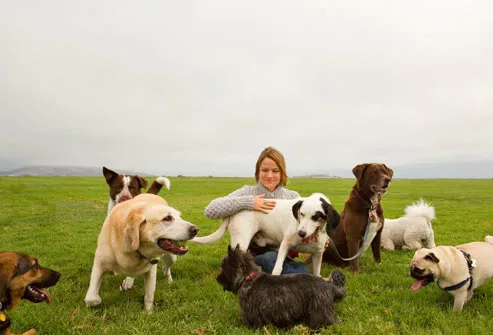
So you've seen the neighbor's cute little puppy and you want one too? You have the money for the initial purchase, but are you really ready? Before you go and grab Fido, consider these things:
Time: All dogs take time, but some dogs take more than others. And not just for the exercise, but also for grooming, training and socialization as well. For instance, though they can be roughly the same size, you are going to spend much more time in the care of a Yorkshire Terrier than you are on a shorthaired Miniature Dachshund.
Money: After the initial purchase is made there is still money to be spent concerning your pet. After all, Fido's going to need food for the rest of his life and veterinary care when he's sick. Also remember to factor in the cost of vaccinations, spay/neuter, and deworming. Not all dogs come fixed or with their shots, and it will be your responsibility to make sure these are taken care of.
Family/roommates: If you have others living in your household, are they okay with the idea of a dog?
If that's managed not to scare you off, there are some things to consider, such as the breed of the dog. Different breeds have different purposes and these purposes play a large role in how your dog will act within environment. So when thinking about a dog to obtain, please consider these important points:
Energy levels: Some breeds of dog are naturally couch potatoes, but many breeds enjoy a lot of activity. This is when it's time to do a little research on the background of your breed. Working and hunting breeds are two categories that were bred for a lot of activity so it's not uncommon for them to require large amounts of exercise and activities. Dogs with large requirements of actives often become bored in houses or yards with nothing to do. This often causes the dog to resort to destructive measures for amusement.
Size: Dogs come in many shapes and sizes. Just because Sparky's a cute little puppy now, doesn't mean he'll necessarily stay that way if you didn't check out the typical adult breed size beforehand. Always check the average height/weight of the breed you'd like.
Grooming: Some dogs need a few minutes a week, some need a few minutes a day. A few need much more. Keep in mind that if you get a dog with long hair, it is possible that you will have to cut it yourself to keep it manageable or you will have to pay someone else to do it. A note on shedding is that it is untrue that long haired dogs shed more. It depends on the breed in question and the weather. A short haired dog like a Lab will probably shed much more over the course of it's life than a dog like a Brittany. The key is a good brushing. Bathing often is more likely to make shedding problems worse than better as your dog's skin dries out.
Warning: Don't buy into the hype you hear. There is no such thing as a 100% shedless dog. Even poodles shed but it is much, much less often and in tight curls. There's no such thing as a 100% hypoallergenic dog either. If you have very severe allergies to dogs then it is likely that dogs named hypoallergenic are still going to cause you some irritation.
Inside or Outside: Where will your dog spend most of it's time? While it's possible for all dog breeds to live indoors (provided the housing is adequate), there are certain breeds of dogs that don't fare well outside due to being prone to certain health problems. "Smush-faced" breeds like English Bulldogs and Pugs will probably have difficulty in hot weather due to breathing problems, while thin or "hairless" breeds like the Chinese Crested don't do well in the cold.
Trainability: Over the years dogs have been bred for different roles. While some are bred to work with constant directions from a handler, others are bred for the ability to move independently of their masters on a regular basis. And while all dogs are trainable, the latter tends to to be more difficult to the beginner. It is best for a new dog owner obtain a dog with ease of trainability.
Prey Drive: Basically, these are the motions a predatory animal goes through when killing prey. In dogs however, prey drive has been modified to suit human purposes. All dogs have some level of prey drive, and it's likely that you've seen it. A dog chasing its ball is exhibiting prey drive. So is a dog that chases a squirrel or a Border Collie that's herding. Prey drive in breeds can be anywhere from high to low, with non-working and lapdog types generally being low and working/hunting breeds generally being high. The level of prey drive can also affect trainability and what can be used to motivate the dog during training. Prey drive may also aid in determining how your dog acts with any other pets you may have or just other animals in general.
Breed purpose: Whether or not you intend to use the dog for it's original purpose or not, you must still be aware of the purposes of the dog you want to obtain if you want to avoid clashes in his personality and yours. For instance, if you were a person who doesn't enjoy noise, then it would be a bad idea to get a dog like a Beagle. While Beagles are cute, they are a breed of dog that is bred specifically bred to make sound as they trail interesting scents, so they cannot be blamed for doing what comes naturally.
Still haven't managed to scare you off? Then let's check out places to obtain a dog.
Shelters: Today, shelters are a popular place to obtain a dog. Dogs present at shelters vary in size and breed. Most dogs at shelters today however, are mixed breeds. Dogs end up at shelters for a variety of reasons, such as seizure from abusive homes and abandonment. The pros of shelter dogs is that they tend to cost less than a dog from a breeder, and they usually come fixed and with shots. The cons are that dogs taken from abusive situations tend to require training beyond the scope of the new owner's capabilities. A dog that is overly nervous may injure a person. Puppies also, must be taken into consideration. While they may be cute, you may never know how large a mixed breed puppy will get or what the temperament is likely to be. However, don't let that scare you off. Shelters have proven excellent places to get yourself a furry friend.
Breed Rescues: Breed rescues are different from shelters in the fact that they tend to deal with the rescuing of one breed and possibly their mixes. They come from several of the same situations shelter dogs can come from. The pros of rescue dogs is that breed rescue dogs tend to be fostered, which can give greater insight to the personality of each dog. They also tend to come with shots and are fixed. The cons of a breed rescue lie mainly in cost of adoption, which is generally much more than found in shelters.
Breeders: Breeders are people that may breed one type of dog or possibly several breeds. Pros of breeders lie in the good breeders. A good breeder knows the personalities of his animals and breeds for temperament along with the physical standards he or she is trying to maintain. A good breeder also knows his breed well and may give you tips in care you hadn't known before. A good breeder will also carefully oversee the selection process and may even help you match a puppy to your personality. Cons lie in bad breeders who are more into breeding for the money, rather than the continued existence and health of the breed. These breeders will allow dogs to go to anyone with little question, so long as the price is right and this can mean a number of bad traits in your dog. Be VERY cautious in breeder selection.
All in all, make sure that you don't rush into getting a dog, and take the time to examine your resources. Communicate freely with the people you are receiving your dog from, and don't be afraid to ask questions or seek alternate opinions.
Good luck with Fido!
-Post submitted by "Good Beef"
Monday, September 14, 2009
Balancing Elephant
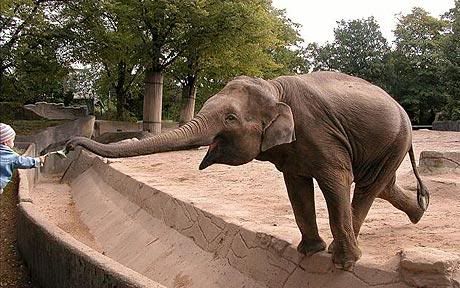 An elephant reaches out its long trunk to gently grab the food from a toddler who was being held up by his father. Photo: BNPS
According to animal rights activists it is unnatural for an elephant to balance like this and they only do so because of "cruel training methods."
Well I don't see anyone in the photograph coercing the elephant to balance on the edge of his enclosure, it looks very much to me as though he's doing it of his own free will.
So who taught the this elephant to balance on it's tiptoes like this? Probably no one.
The animal spotted a curious toddler holding a snack and clambered up onto a narrow wall on the edge of its enclosure to snatch it.
Balancing on its tiptoes the elephant teetered precariously on the four inch wide ledge. It then reached out its long trunk out to gently grab the food.
The moment was captured by amateur photographer Tobias Haase, during a visit to Hamburg Zoo in Germany.
Subscribe to:
Posts (Atom)